I normally don't post in quick succession, but I wanted to let you all know that this happened!
My O2 saturation levels have improved to the point that I'm only using my portable when I walk outside (to/from campus and for exercise). However, I've been very frustrated that I can't do anything more strenuous than walking. Being a runner and athlete is a core part of my identity. From the time I began running in spring 1989 until the day before I landed in the ICU last summer, the only times I didn't do 4-6 days/week of intense cardio were a trip to Morocco in 2000 and 2 trips to Ghana in the 2010s. I ran 25-30 miles/week for 6 months in San Salvador in 1993, at a time when the only other people I saw running were male football/soccer players. During my 8 months in rural El Salvador in 2001, running involved doing figure-8's around 2 soccer fields with long grass hand-cut with machetes. At one end were a horse or cow or two, pigs, chickens, a pack of stray dogs--and a group of kids yelling "Gringa! Gringa!" every time I completed a loop. I ran in the city on weekends, despite drivers unaccustomed to runners, sketchy roads and sidewalks, catcalls, hilly terrain, air pollution, and more. I ran until the day before Lily was born. Even during running injuries, I biked, x-country skied, did high-intensity interval workouts, or ran in a pool. You get the picture. Losing my fitness and identity as an athlete has been one of the hardest things about lung cancer and recovery from pulmonary emboli.
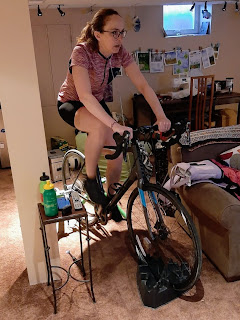
For a while I'd been thinking about setting up my indoor road bike stand, biking outside once the weather warms up, and taking up strength training. In each of these situations I could use the portable concentrator and take breaks if needed. I met with my pulmonologist last Friday to get my portable re-authorized (due to health insurance switch) and asked him about these options. He saw no problem with it, as long as I monitor my O2 saturation.
Leland set up my bike stand on Saturday. The last 3 days, I've ridden for 45 minutes and maintained good O2 levels while getting my heart rate up to 110-140. While biking, I watched 14 Peaks: Nothing is Impossible on Netflix. It's about a Nepali man, Nims Purja, who set out to climb all 14 mountains higher than 8000 meters in less than 7 months (the record was 7 years), an endeavor he called Project Possible. With the help of his support team, he did it in 6 months and 1 day. Starting to exercise again feels like embarking on my own Project Possible. I've come a long way, and I still have mountains to climb.

So glad to hear this, Esther! Strenuous exercise is beneficial on so many levels. I watched "14 Peaks" when I was in bed with COVID last summer. It's a great motivator!
ReplyDeleteThank you! COVID sucks, but good TV makes it better.
DeleteThanking God with you for this outlet for a rigorous workout, Esther!! Way...to...go!! Cheering you on as you tackle Project Possible! ....and I'm in awe for all that running you did, even in the most daunting circumstances.
ReplyDeleteThank you, Irene!
DeleteFabulous news! You go girl ! Rock that bike !!
ReplyDeleteThank you, Dolores!
DeleteThis is wonderful news - as an activity addict, I can imagine how hard it would be to loose your options for staying fit.
ReplyDeleteThank you! Yes, it's tough.
DeleteAwesome! So glad to hear this.... rock it!
ReplyDeleteThank you, Lara!
DeleteYou are such an inspiration 🥰
ReplyDeleteThank you, Nicky!
DeleteI hope it felt really good to move :-)
ReplyDeleteYes, it definitely does. Starting strength training on Tuesday!
DeleteMy first thought has already been written, but to repeat: “You go girl!”
ReplyDeleteAdmire your determination to restore your health.
Thank you, anonymous friend!
DeleteWell done Esther. Proud of you!
ReplyDeleteThank you, Simon! Hope you are well in MN.
DeletePraise God for the walking, indoor biking and small hills you will climb. One day you will see you don’t even need portable oxygen. In the name of Jesus 🙏🏽
ReplyDeleteThank you, Alisa!
Delete